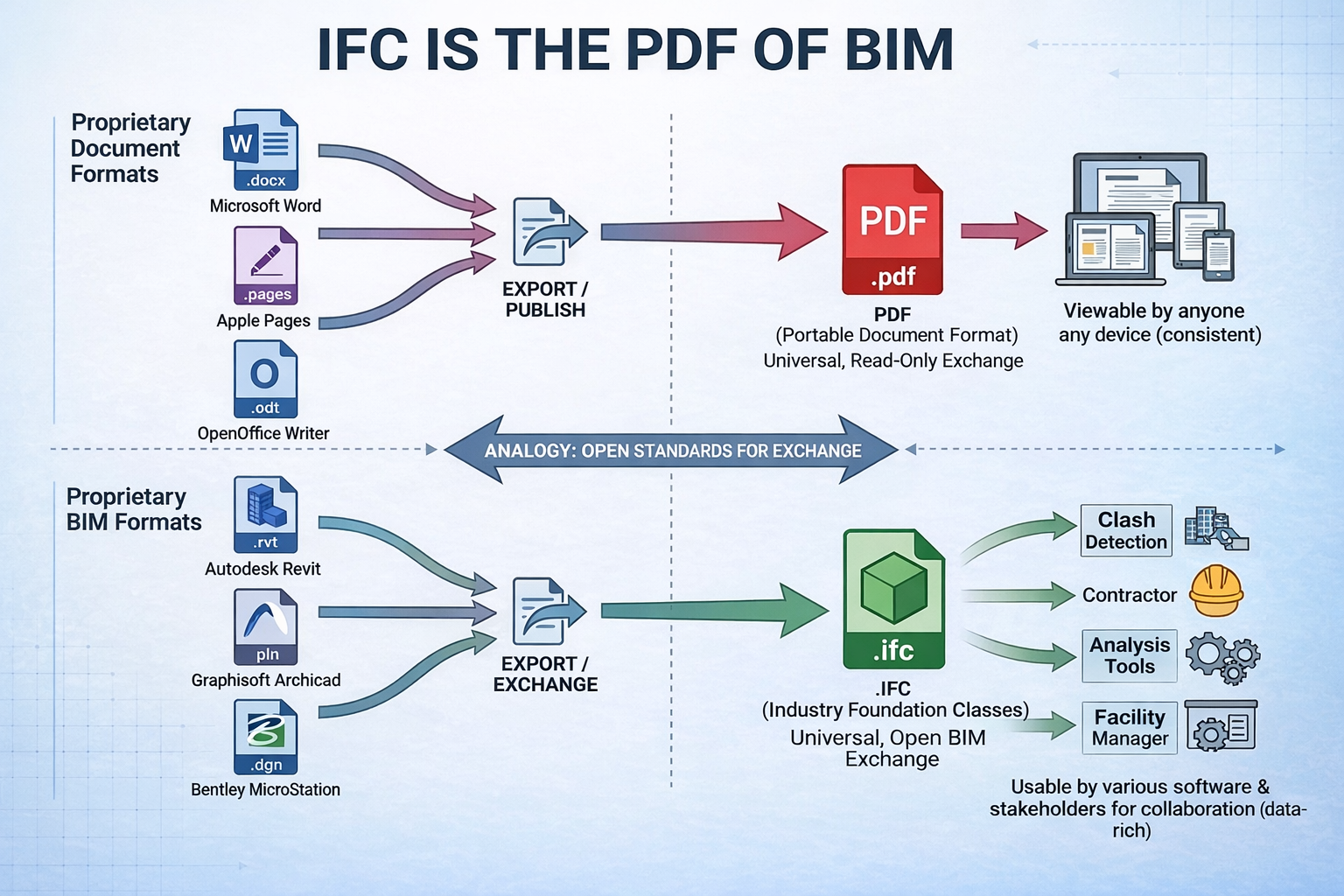
What Is IFC?
IFC (Industry Foundation Classes) is an open, neutral data standard used to describe buildings and infrastructure in a software-independent way.
It allows BIM information to be shared, checked, and reused across different tools, organizations, and project phases.
Why IFC Exists
In many BIM projects:
- Teams use different software
- Native files cannot be reliably exchanged
- Information is lost or misinterpreted
- Long-term access to data is uncertain
IFC was created to solve this.
Purpose of IFC:
Enable reliable, consistent exchange of building information without vendor lock-in.
Who Develops IFC?
IFC is developed and maintained by buildingSMART International.
It is:
- An open standard
- Publicly documented
- Not owned by any software vendor
What IFC Is (Simple Definition)
IFC is:
- A data schema (not software)
- A neutral format for BIM information
- A way to describe what a building element is, not just how it looks
IFC can describe:
- Geometry
- Properties (data)
- Relationships between elements
- Spatial structure of a building
What IFC Is NOT
IFC is not:
- A BIM authoring tool
- A replacement for native models
- A “Revit file” or “Archicad file”
- Just a 3D model
IFC focuses on information, not authoring features.
What Kind of Information IFC Contains
1. Objects
Examples:
- IfcWall
- IfcSlab
- IfcDoor
- IfcWindow
- IfcSpace
Each object has a defined meaning, not just geometry.
2. Geometry
IFC includes:
- 3D shape
- Location
- Orientation
Geometry is important, but not the main value of IFC.
3. Properties (Data)
Objects can have:
- Names
- Types
- Dimensions
- Fire ratings
- Space usage
- Custom project data
4. Relationships
IFC defines how things relate:
- Which elements belong to which storey
- Which spaces are inside which building
- Which components are connected
IFC Spatial Structure (Very Important)
IFC organizes buildings in a clear hierarchy:
- Site
- Building
- Storey
- Space
- Elements (walls, slabs, doors…)
- Space
- Storey
- Building
This structure allows software and reviewers to understand the building logically, not just visually.